
Why Are Cash-Pay Labs Cheaper Than Insurance?
Confused by a surprise lab bill? Here's how cash-pay labs work, why they're often cheaper than going through insurance, and how to order the ones you actually need. (I'll share my go-to resource at the end.)
Key Takeaways
Cash-pay labs are often significantly cheaper than the same test billed through insurance — a vitamin D test can run $25 cash vs. up to $180+ if billed and denied by insurance.
Insurance companies frequently mark up lab prices, and if a test is deemed "not medically necessary," that inflated cost becomes your bill.
Testing proactively — before symptoms appear — can catch issues like iron deficiency or low vitamin D early, when they're simpler and cheaper to correct.
Standard labs often miss early markers of insulin resistance (like fasting insulin, triglycerides, and inflammation markers) that can show up years before a prediabetes diagnosis.
My new Lab Journeys program lets you order the same cash-pay panels I use with patients — without needing to be an existing client.
Why I Started Ordering Cash-Pay Labs (A Patient and Clinician Perspective)
I’m not a doctor, but I need labs to properly assess my patients’ nutrition status and disease risk, make appropriate diet, lifestyle, and supplement recommendations, and monitor their progress. To do this, I rely on “cash labs.” This means I order them at cost, at a substantially lower price than what insurance companies are billed. You pay for labs up-front (knowing exactly what the price will be), and we get the data we need without having to beg your insurance company for coverage. No surprises and WAY less money.
It’s time to let you in on this great system so you can get the labs you need too. But first, I’m going to explain (briefly?) how this system got so confusing and how I finally figured it out.
I learned my lesson about labs the hard way… from both the angle of the patient and the practitioner.
Me the Patient
I have a high-deductible health insurance plan. So around the time I was starting menopause, I asked my doc for some labs that seemed like a good idea. Estrogen, progesterone, testosterone, vitamin D, Lp(a), etc.
3 months later, I got a lab bill for almost $300.
Turns out, my insurance didn’t even cover vitamin D for a 50-year-old woman. That lab alone cost $120!!
Me the Clinician
As a nutritionist, I’d often see a new patient and need some labs run. Maybe an iron panel, vitamin D, homocysteine, and/or fasting insulin. I’d write to their doc requesting these labs, and maybe I’d get a ferritin lab if I was lucky. That’s it. Were they not listening to me? Didn’t they care about their patients’ nutrition?
Then I realized they were protecting their patients from that inevitable bill for denied insurance claims. The docs knew something I didn’t. They knew how much our patient would be on the hook for and how mad they’d be when they got the bill.
It wasn’t long before I learned there was a cheaper way to order labs, and why this system is so confusing.

Why Insurance-Billed Labs Cost More Than Cash-Pay Labs
Here's what most people don't realize about how lab billing works: when a test goes through insurance, the lab often bills at a significantly marked-up rate — sometimes several times higher than what the same test costs if you simply pay cash up front.
As shown in this 2019 study by the Health Care Cost Institute, a lab looking at vitamin D, which is often not covered by insurance, can range from $25 to $180.
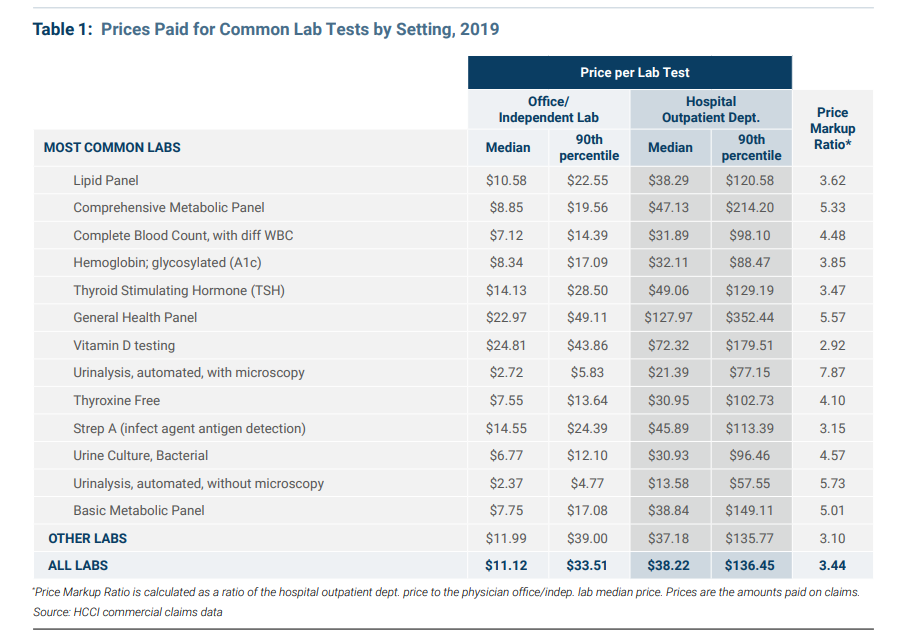
If your insurance decides the test wasn't "medically necessary" for your visit, that inflated number doesn't disappear. It becomes your bill.
Compare that to paying cash directly.
Vitamin D test: This can run over $100 if billed through insurance and denied, versus roughly $25 cash pay. Vitamin D isn’t often covered unless you meet criteria. The criteria includes diagnosed osteopenia, Crohn’s disease, Celiac Disease, kidney disease, and a few other conditions which can affect your nutrient absorption.
Iron panel: This is frequently left off standard physicals altogether. But you’ll pay $60 and up, depending on the price negotiated by your insurance company, if you’re left holding the bag. If you paid cash up front, it would have been around $16. An iron panel won’t be covered unless there is a strong suspicion of iron-deficiency anemia already
The takeaway isn't "insurance is bad." It's that for the specific, proactive tests this article is about, paying cash directly is often simpler, more predictable, and frequently cheaper than running it through insurance at all.
(A quick note: this isn't an argument against your doctor or your insurance. Think of cash-pay labs as a complement — a way to get data your standard visit doesn't capture, without disrupting the care you're already getting.)
What Iron and Vitamin D Teach Us About Waiting for Symptoms
Most lab testing is reactive by design. You get tested when something's already wrong — when you're tired, when your hair is thinning, when sleep has gone sideways. By the time those symptoms show up, and a standard panel finally flags something, you're often not catching a problem early. You're climbing out of a hole.
Take iron deficiency anemia. Iron stores typically deplete gradually, long before fatigue becomes noticeable enough to mention at an appointment. Once labs catch it, you're not just fixing a number — you're rebuilding depleted reserves, which commonly takes a minimum of three months of consistent supplementation or iron infusions before you feel like yourself again. When I’m testing a young person like a 15-year-old girl, cash labs can cover all the needed tests in one trip and catch iron deficiency before it impacts her growth and learning.
Compare that to checking an iron panel proactively, before symptoms appear. If your levels are trending down, the fix at that stage is often as simple as a dietary adjustment — no months of fatigue, no hair loss, no sleepless nights required. (Read more about iron deficiency anemia and the tests to order HERE)
Vitamin D works similarly, just in reverse. Most people guess at their dosage — take a supplement, hope it's enough, hope it's not too much. Without a baseline test, you genuinely don't know. Testing first means you supplement with precision instead of guesswork, and you can confirm it's working with a follow-up test rather than hoping for the best.
Or worse… you never test your vitamin D until you break your wrist at 59. The workup reveals osteoporosis and low vitamin D levels. If those levels had been checked and optimized when you were ages 35 through 50, you might have prevented this.
What Labs Catch Insulin Resistance Before Your A1c Rises?
If you've read Hack Your Blood Sugar, you already know that the conventional approach to metabolic health also has a timing problem. Most standard care waits for your HbA1c to cross 5.7% before anyone uses the word "prediabetes." But your A1c is a lagging indicator — it reflects average blood sugar over the past three months, not what's actively happening at the cellular level right now.
By the time A1c rises, the metabolic strain behind it — insulin resistance, low-grade inflammation, your cells working harder than they should to manage glucose — has often been building for years.
A more complete picture of metabolic health usually requires looking at a few markers that aren't part of a standard physical:
Fasting insulin — often the earliest warning sign of insulin resistance, frequently elevated years before glucose or A1c levels move at all. I like to see it between 3-7.
Triglycerides — another good marker of chronically elevated insulin and heart disease risk.
Liver markers — ALT, AST, GGT — early metabolic strain often shows up here before it shows up anywhere else.
hs-CRP (inflammation marker) — gives insight into the low-grade inflammation that frequently accompanies insulin resistance.
NLR (neutrophil-to-lymphocyte ratio) — this is a simple calculation that tells us about levels of inflammation in your body. We pull this off the CBC with differential.
Iron Panel — Anemia will cause inaccurate A1c levels, so it’s important to check. Also, ferritin doubles as a marker of inflammation.
None of these are exotic. They're just not all default orders on a standard panel — which means most people never see them until something has already gone wrong.
What Is Lab Journeys and How Does It Work?
You shouldn't have to wait for a crisis to get data about your own body. That's the whole idea behind something new I'm offering: Lab Journeys.
For the first time, you don't need to be an active one-on-one client to access the specific metabolic lab panels I use with patients. Here's how it works:
Browse & select. Visit my Fullscript Lab Menu to view panels built around metabolic health, blood sugar regulation, and vitality after 50.
Purchase & schedule. Pay one transparent, upfront cash price — no surprise bill two months later — and book a quick draw at a local Quest Diagnostics location near you. (Quest is the same lab your doc probably uses.)
Get your results. Your digital lab report comes straight to you, along with a personalized navigation note from me, walking you through what your numbers actually mean.
From there, the choice is yours. Bring your results to your primary doctor to discuss together, or book a strategy session with me to build a targeted plan around what your labs show… or both.
Which Lab Panel Should You Order?
Iron Deficiency: I’ve created a specific panel just to screen someone for iron deficiency anemia called Anemia Screen. This one is important for many people, but especially teenage girls. Read more on iron deficiencies and testing.
Prevent Diabetes: The Hack Your Blood Sugar panels are designed for this. I created a “complete” and a “basic” panel to give you price options. If you’ve read my book and want to do your due diligence, these are for you.
Heart Disease Risk: If your cholesterol numbers have gone up and you and your doc are talking medication, but you’d like more information, this is a start. An expanded lab panel that looks at risk factors like inflammation, insulin resistance, Lp(a), and lipid particle size will help guide you towards smarter strategies. For now, you’ll find the Advanced Lipid Panel which includes NMR particle size, Lp(a), LpPla2 and more.
Do Your Future Self a Favor
If Hack Your Blood Sugar Using a Continuous Glucose Monitor gave you the instruction manual for understanding your glucotype, these lab panels are the missing data — the actual numbers that tell you which chapter applies to you right now, not just in theory.
Taking control of your health was never about being perfect. It's about being proactive enough to see the trend before it becomes a crisis, and refusing to let a billing department be the reason you didn't know.
FAQs
-
Insurance often bills labs at a marked-up rate — sometimes several times the cash price. If a test is deemed "not medically necessary," that inflated price becomes your bill instead of being covered. goes here
-
Description text A vitamin D test can cost around $25 cash-pay, versus over $100 (and up to $180) if billed through insurance and denied. Insurance typically won't cover vitamin D testing unless you meet specific criteria — like diagnosed osteopenia, Crohn's disease, Celiac disease, or kidney disease.goes here
-
An iron panel runs about $16 cash-pay, versus $60 or more if billed through insurance — and even then, it's only covered if there's already a strong suspicion of iron-deficiency anemia.
-
Lab Journeys is my cash-pay lab ordering service. You don't need to be an existing one-on-one client — you browse my Fullscript lab menu, pay one upfront price, get drawn at a local Quest Diagnostics, and receive your results along with my personalized notes on what they mean.
-
Fasting insulin, triglycerides, liver markers (ALT, AST, GGT), hs-CRP, and NLR (neutrophil-to-lymphocyte ratio) can flag insulin resistance and inflammation years before A1c or glucose levels move. My Hack Your Blood Sugar panels — available in "basic" and "complete" versions through Lab Journeys — are built around these markers.
-
No — Lab Journeys is open to non-clients, which is new. You can order the same panels I use with my one-on-one patients.
-
Browse my Fullscript Lab Menu and select a panel, pay one upfront cash price and book a draw at a local Quest Diagnostics location, then receive your digital results along with my personalized notes explaining what they mean.